Your first paper, from blank page to someday submitted.
Two live days on finding a gap that is actually open, designing an experiment that answers it, writing the paper, and surviving peer review — taught with one real paper's draft, reviewer scores, rebuttal and accepted version on screen.
4 hours live Recording for 90 days Workbook + templates 60 seats
The competition
Nobody taught you to write one. Everybody is writing one.
Coursework teaches you to solve problems. It does not teach you to find one worth solving, or to argue for it in eight pages against reviewers with four other papers due the same night.
papers submitted to NeurIPS 2025 alone — 61% more than the year before.
of them were rejected. 5,290 of 21,575 made it in.
Acceptance rate 24.5%
A good idea is not enough any more. What separates an accepted paper from a desk reject is craft: a gap stated precisely, a claim matched to the evidence, a baseline nobody can object to, and a rebuttal that answers the reviewer instead of arguing with them. That craft is learnable in a weekend. Most people spend three years picking it up by rejection.
Fit
Who this is for — and who should skip it.
Come if you are
- A final-year UG or PG student with a project you suspect could be a paper
- A first- or second-year PhD scholar who has not published yet
- Sitting on results you have never written up
- Writing a paper now and unsure whether the contribution is real
- Coming back after a reject and not sure what the reviewers actually meant
Skip it if you are
- Looking for a guaranteed publication — we teach the craft, not a shortcut
- Hunting for paid or predatory journals that publish anything for a fee
- Already published three or more peer-reviewed papers
- Expecting us to write, or an AI to write, the paper for you
- Unable to attend live — the exercises are the point
Take-home
You leave with six things you can open on Monday.
Not notes. Working files, filled in with your own research during the sessions.
Gap matrix
Your area's papers on one axis, their assumptions and limits on the other. The empty cell is your paper.
Paper template
Venue style file, sections split into their own files, refs.bib, a sample table and figure that already compile.
Prompt library
Tested prompts for literature sweeps, related-work drafting and self-review — every one tried on at least two models.
Pre-submission review
The self-review pass, a venue cheat sheet, and the red-flag list that catches a desk reject before a reviewer does.
Exercise workbook
One exercise per section, plus the Day 1 homework you bring back to Day 2.
Both days, 90 days
Full recordings and every slide, so you can replay the LaTeX and rebuttal sections while you write.
Curriculum
Two days, in the order the work actually happens.
Day 1 decides what you are writing. Day 2 writes it and sends it.
Saturday 24 October · 7–9 PM IST · bring three papers from your area
What actually counts as a contribution
Five contribution types reviewers recognise, and the four that look like contributions but are not.
Reading a field in an afternoon
Search strategy, citation chaining, and where LLMs help versus where they invent references. Live demo.
Building your gap matrix
Hands-on: you fill the sheet with your three papers while we do the same on screen.
From gap to hypothesis to experiment
Turning a hole in the literature into a claim, and a claim into the smallest experiment that could falsify it.
Baselines, ablations and the questions reviewers always ask
What to compare against so the obvious objection is already answered in the table.
Live Q&A and homework
Finish your gap matrix overnight. We review a handful on Day 2.
Sunday 25 October · 7–9 PM IST · bring your completed gap matrix
Anatomy of a paper, section by section
What each section is for, in what order to write them, and the one paragraph that decides your fate.
The abstract formula
Six sentences. We rewrite a real abstract live, before and after, and you rewrite yours.
LaTeX without the fight
Overleaf set-up, tables and figures that do not drift, BibTeX, and the three errors that eat an evening.
Choosing the venue — and spotting the fake ones
Conference versus journal, how to read a call for papers, and how paid and predatory outfits advertise themselves.
Reviews, rebuttals and resubmission
Reading a harsh review for what it is asking, and writing the rebuttal that changes a score.
Declaring AI use, and what comes next
Current disclosure rules at the venues we cover, your submission plan, and how to keep going after today.
The running example
One real paper, opened up — including the reviews that hurt.
Most workshops show you finished papers. Finished papers teach you nothing, because every decision that mattered has been erased. We show the draft, the scores, the rebuttal and the diff.
In this paper we propose a novel framework which achieves good results on several benchmarks and outperforms many existing methods. We show that retrieval-augmented models degrade by 14 points when the retrieved passage contradicts the question—a failure mode three prior benchmarks miss because they never test it. We introduce a 2,400-item diagnostic set and a fine-tuning recipe that recovers 11 of those points.
Struck text: the version that got the low scores. Marked text: the version that got in.
The draft we sent
Vague claim, no diagnostic, baselines chosen for convenience.
Three reviews
Read line by line, including the one that misread the method.
The rebuttal
What we conceded, what we defended, and the one experiment we ran in four days.
Accepted
The diff between the two versions, sentence by sentence.
Who is teaching
Two published authors, not two marketers.
Both of us are PhD scholars who went through this last year. Every paper we cite, you can open.

Balaji Venktesh
PhD scholar · Small language models for code
First author of Capacity vs. architecture: an evaluation of SLMs for automated docstring generation, in Automated Software Engineering (Springer, 2026), and co-author on a second paper in Information Processing & Management.
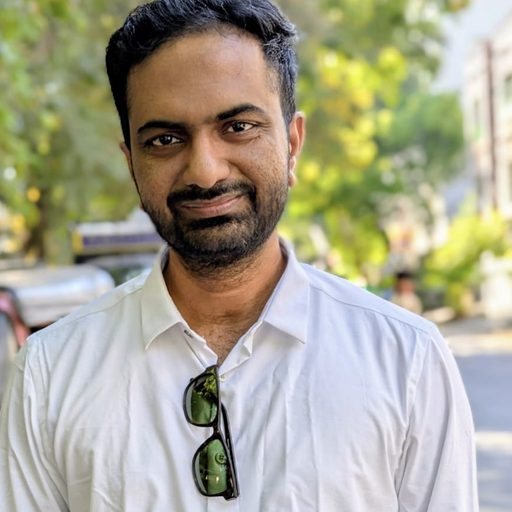
Gireesh Sundaram
PhD scholar · Agentic AI for software engineering
First author of Epistemic fortitude: architectural specialization for sycophancy mitigation in software engineering agents, in Information Processing & Management (Elsevier, in press), and co-author on a second paper in Automated Software Engineering.
Format
Everything you need to know before you pay.
- When
- 24 & 25 OctSaturday and Sunday, 7–9 PM IST
- Where
- ZoomLink emailed 23 Oct; waiting room on
- Seats
- 60Capped so live Q&A stays useful
- Recording
- 90 daysPlus slides, templates and workbook
Questions
The things people ask us in DMs.
I have never used LaTeX. Will I keep up?
Yes. We start from an Overleaf project that already compiles and you edit it live. You never install anything.
Does this only work for computer science?
The craft — gap finding, claims, structure, rebuttals — is the same across empirical fields. Our examples come from software engineering and machine learning, and we ask your research area on the registration form so we can pick examples close to the room.
Will you help me publish my specific paper?
Not inside the two days — there is not time to do it justice for everyone. We offer one-on-one sessions separately, introduced at the end of Day 2.
Can I attend only one day?
You can, but Day 2 builds on the gap matrix you fill in on Day 1. The price covers both either way.
What if I miss a session?
Both days are recorded and the link reaches you within 24 hours. You keep access for 90 days.
Is using AI to write papers even allowed?
It depends on the venue, and the rules changed recently. We go through the current disclosure requirements of every venue we mention, and we re-check them the week before the workshop.
Do I get a certificate?
Yes, after both days, sent with the recording and materials.
How do I pay, and is a refund possible?
Cards, UPI, net banking and wallets through Razorpay. Full refund on request before 21 October. Details in the refund policy.
Price
Less than one rejected submission fee.
One price, both days, everything included. No upsell required to follow along.
₹499
Until 11 October, 11:59 PM IST
- Both live days, 4 hours total
- Recording access for 90 days
- Workbook, Overleaf template, gap matrix, prompt library
- Certificate of completion
- Student WhatsApp group and post-workshop Q&A
₹999
Same workshop, same materials
- Everything in early bird
- Subject to remaining seats
Full refund if you cancel before 21 October, or if we cancel the workshop. See the refund policy.
Register
Take a seat.
Pay first, then tell us about your research so we can tune the examples to the room.
1. Pay ₹499
Card, UPI, net banking or wallet. Secured by Razorpay. You get a confirmation email immediately.
Questions before you pay? Write to hello@firstauthor.in or message us on WhatsApp.
2. Tell us about your work
Takes a minute, and it tunes the examples to the room. It also gets you The six-sentence abstract — three pages, free, whether or not you register.
- The formula: one job per sentence, with the trap each one falls into
- Two abstracts rewritten from the version that scored 2s — one in machine learning, one in power systems
- Structured abstracts, keywords, titles, word swaps and the desk-reject tripwires
- A worksheet to write your own six in, and two prompts that make an LLM critique it instead of writing it
Sent
Here is your cheat sheet.
Five pages: the formula, two worked examples, the word swaps and the cold-read self-check, and a worksheet to fill in. A copy is on its way to your inbox as well.
Download the PDF — 5 pagesBring it to Day 2 — we rewrite your own abstract against it.